
-
Hours
Mon - Sat 8am - 8pm
Hardscape Lighting Ideas for Patios, Steps, Walls & Walkways

Hardscape lighting ideas turn a patio, a set of steps or a stone wall into something you actually use after dark. Done well, lighting makes the space safer, shows off the stonework you paid for, and stretches your evenings outside well into the fall.
We've been designing and building outdoor spaces across Halton Hills for over 35 years, and lighting is the upgrade clients most often wish they'd done sooner. Below are the ideas that make the biggest difference, plus what to know before you hire someone to install them.
Quick answer: the best hardscape lighting ideas
The eight hardscape lighting ideas that make the biggest difference are step lights, wall cap lights on retaining and seat walls, path lights, in-ground lights in patio pavers, uplighting on trees and the house, firepit and seating area lighting, water feature lighting, and driveway and entry lighting.
- Best for safety: step lights built into the risers
- Best for showing off stonework: wall cap lights
- Biggest wow from the street: uplighting a tree or the front of the house
- Best money saved: planning the wiring before the patio goes in
Most systems are low-voltage LED, use warm white light and run on a timer or photocell.
TL;DR:
- Light the places people walk first (steps, paths, edges), then the features you want to show off
- Plan lighting with the patio or walls, not after, so wiring goes under the base
- Stick to warm white light and aim fixtures away from neighbours' windows
- In Ontario, keep fixtures clear of where snow is shovelled or plowed
- Low-voltage LED is safe, efficient and the standard for residential work
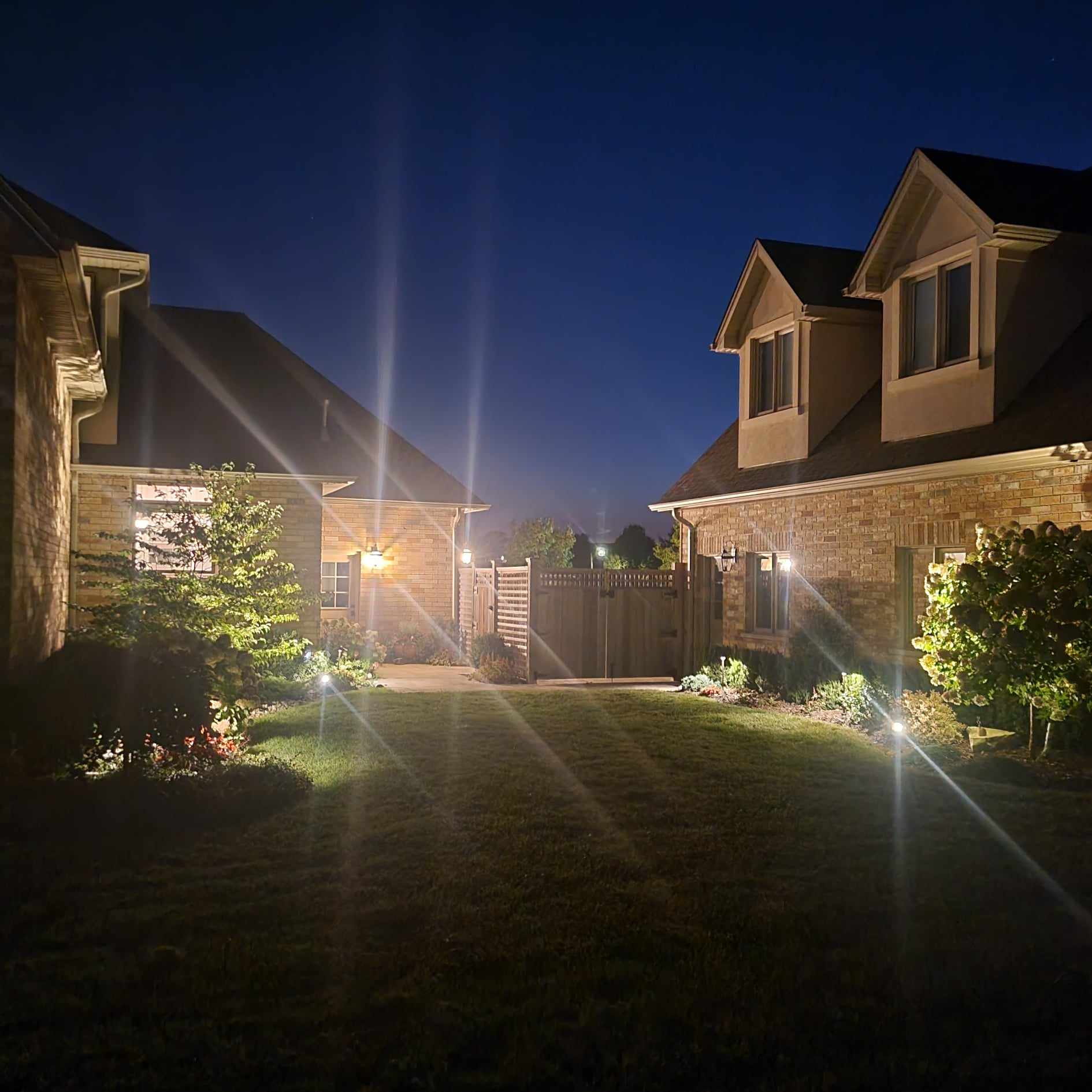
Key Takeaways Before You Light Your Hardscape
- Safety first, then show: steps and changes in level are where people trip, so they get lit before anything decorative.
- Less is more: a few well-placed fixtures look better than a runway of path lights.
- Timing saves money: wiring is far easier to run before pavers and wall caps go down.
- Winter matters here: fixtures need to survive freeze-thaw, snow clearing and road salt.
- Control it: a timer, photocell or app means the lights come on without anyone thinking about it.
8 Hardscape Lighting Ideas That Make the Biggest Difference
1. Step Lights Built Into the Risers
Steps are the number one place people trip after dark. Small fixtures set into the riser of each step, or every second step, throw light down onto the tread without shining in anyone's eyes.
Where it works: front entry steps, deck stairs, and steps between patio levels.
Tip: these are easiest to install when the steps are being built, since the fixture sits inside the stone.
2. Wall Cap Lights on Retaining and Seat Walls
Small lights tucked under the cap of a retaining wall or seat wall wash light down the face of the stone. It shows off the texture of the wall and gives a soft glow around the patio without any visible fixtures.
Where it works: retaining walls, raised planters, seat walls and pillars.
Tip: space them evenly and keep them all on one side of the wall, or the effect looks patchy.
3. Path Lights Along Walkways
Path lights mark the edges of a walkway and guide people to the door or the back gate. The trick is to stagger them on alternating sides rather than lining both edges like an airport runway.
Where it works: front walkways, side yards and garden paths.
Tip: set them into the planting bed, a little back from the edge, so they don't get kicked or clipped by the snowblower.
4. In-Ground Lights in Patio Pavers
Small, flush-mounted lights set right into the interlock mark the edge of a patio or the outline of a walkway. Because they sit level with the pavers, you can walk and shovel right over them.
Where it works: patio borders, pool decks and driveway edges.
Tip: these need to be planned with the interlock patio or walkway, since they're set into the base as the pavers go down.
5. Uplighting Trees and the Front of the House
A light at the base of a tree, aimed up into the canopy, is the single most striking effect you can add. The same goes for washing light up the front of the house between windows. It gives the property depth and makes it look great from the street.
Where it works: specimen trees, stone or brick facades, columns and tall evergreens.
Tip: pick the tree first. A Japanese Tree Lilac or a multi-stem Serviceberry lights up beautifully. See our guide to the best trees for a front yard in Ontario.
6. Firepit and Seating Area Lighting
Around a firepit, the fire should be the star. Low, soft lighting on nearby seat walls or steps lets people move around safely without washing out the flames.
Where it works: firepit patios, outdoor fireplaces and conversation areas.
Tip: put this zone on its own switch or setting so you can dim it down when the fire's going.
7. Water Feature Lighting
Underwater or spotlight fixtures on a pond, fountain or waterfall bring movement and reflection to the yard at night. It's one of the most relaxing effects you can add.
Where it works: ponds, pondless waterfalls and fountains.
Tip: light the falling water or the plants around the edge rather than pointing lights straight at the surface. See our water features page for more.
8. Driveway and Front Entry Lighting
Lighting at the end of the driveway, on pillars and around the front door helps visitors find the house and makes it feel secure. It's also where curb appeal is won or lost at night.
Where it works: driveway entrances, pillars, front porches and house numbers.
Tip: in Ontario, keep driveway fixtures recessed or well back from the edge. The plow and the shovel will find anything that sticks up.
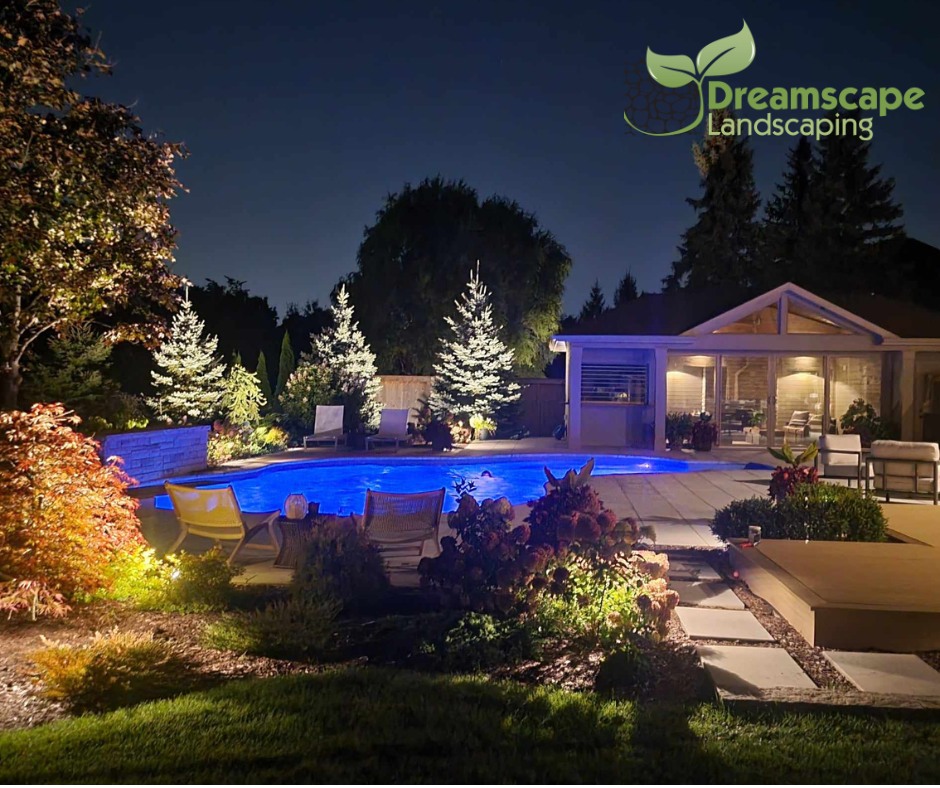
Plan Hardscape Lighting Before the Patio Goes In
This is the biggest money-saving tip we can give. When lighting is planned at the design stage, conduit and wiring go in under the base, and step and wall lights are set into the stone as it's built.
Adding lighting after a patio is finished is still doable, but it usually means lifting pavers, running wire along edges or settling for fixtures in less ideal spots. If you're planning a new patio, wall or backyard renovation, bring lighting into the plan from day one.
How a Professional Lighting Install Works
Almost all residential landscape lighting today is low-voltage LED. A transformer plugs into an outdoor GFCI outlet and steps the power down to a safe 12 volts, which runs out to the fixtures through buried cable.
- Design: we walk the property at the planning stage, decide what to light and how, and lay out fixtures and zones.
- Fixtures: step, wall cap, path, in-ground and uplights chosen for each spot, rated for outdoor use and sealed against moisture.
- Wiring: cable run in shallow trenches or conduit, ideally under the patio base before the pavers go down.
- Controls: a timer, photocell or app so the lights come on at dusk and go off on their own.
If you need a new outdoor outlet or any line-voltage wiring, that falls under the rules of Ontario's Electrical Safety Authority and should be done by a licensed electrical contractor.
Modern LED systems are very efficient. A small backyard setup with 8 to 10 well-placed fixtures can use about the same total power as a single old 60-watt bulb, and many of the professional-grade fixtures we use come with 15-year warranties.
Hardscape Lighting in an Ontario Climate
Lighting that looks great in a California catalogue doesn't always survive a Halton Hills winter. A few things matter more here:
- Snow clearing: anything in a driveway or walkway that sticks up will get hit. Recessed and wall-mounted fixtures are safer bets.
- Salt: keep fixtures and connections out of the salt spray zone along the road and driveway where you can.
- Freeze-thaw: sealed fittings and properly buried cable stop moisture getting in and heaving things out of place.
- Long evenings: it's dark by 5 pm from November to February, so good lighting gets more use here than almost anywhere.
Fall is a good time to install. The ground is still workable, and you'll have the lights in place for the darkest months of the year.
Keep It Warm, Soft and Neighbour-Friendly
The most common lighting mistake is too much light. Bright, cool-white fixtures make a yard look like a parking lot and shine straight into the neighbours' windows.
- Colour: warm white, around 2700K to 3000K, flatters stone, wood and plants.
- Direction: aim light down or at the feature, not out across the yard.
- Glare: use shielded fixtures so you see the effect, not the bulb.
- Light trespass: keep light on your own property. DarkSky International has good guidance on lighting that doesn't spill onto neighbours or into the night sky.
What to Ask Before You Hire a Lighting Installer
- Will you show me a lighting plan before anything is installed?
- Are the fixtures low-voltage LED, and what warranty do they carry?
- How will the system be controlled, and can I change zones later?
- How will fixtures handle snow clearing and salt?
- Can the system be expanded if I add a patio, wall or garden later?
A good installer will answer all of these without hesitating, and should be happy to come back after dark to fine-tune the aim of each light.
Get a Hardscape Lighting Quote
Dreamscape Landscaping designs and installs landscape and hardscape lighting in Halton Hills, and because we build the patios, walls and walkways too, we can plan the lighting as part of the job instead of an afterthought.
We work across Halton Hills, including Georgetown, Acton and Limehouse, plus Erin and Rockwood. Browse our landscaping projects, or call 647-234-7907 or request a free quote to talk about lighting for your property.
Hardscape Lighting FAQs
What is hardscape lighting?
Hardscape lighting is outdoor lighting built into or aimed at the hard parts of a landscape: patios, steps, retaining walls, seat walls, walkways and driveways. It is usually low-voltage LED, and it makes those areas safer and more usable after dark while showing off the stone and interlock.
Should lighting go in before or after a new patio?
Before, or at least during. When lighting is planned with the patio, wiring and conduit go in under the base and fixtures can be set into steps and wall caps as they are built. Adding it later is still possible, but it usually means lifting pavers or running wire around the edges.
Do outdoor lights survive Ontario winters?
Good quality low-voltage LED fixtures handle Ontario winters well. The bigger risks are snow shovels, plows and salt, so fixtures in driveways and walkways should be recessed or set back from where snow gets cleared, and fittings should be sealed against moisture.
What colour of light is best for a patio?
Warm white, roughly 2700K to 3000K, is the best choice for most patios and gardens. It flatters stone, wood and plants and feels relaxing. Cool white light can look harsh outdoors and is better kept to security or task lighting.
Do I need an electrician for landscape lighting?
A low-voltage landscape lighting system plugs its transformer into an existing outdoor GFCI outlet. If you need a new outdoor outlet or any line-voltage wiring, that falls under Ontario's Electrical Safety Authority rules and should be done by a licensed electrical contractor.